
Sunita Tanwar
India
Sterol Transport Protein Modulates Amphotericin B Drug Resistance in Sacchromyces cerevisiae
SUNITA TANWAR 1, DR. VINAY KUMAR BARI2
1. PhD SCHOLAR CENTRAL UNIVESITY OF PUNJAB, BATHINDA
2. ASSISTANT PROFESSOR CENTRAL UNIVERSITY OF PUNJAB, BATHINDA
Abstract
Background
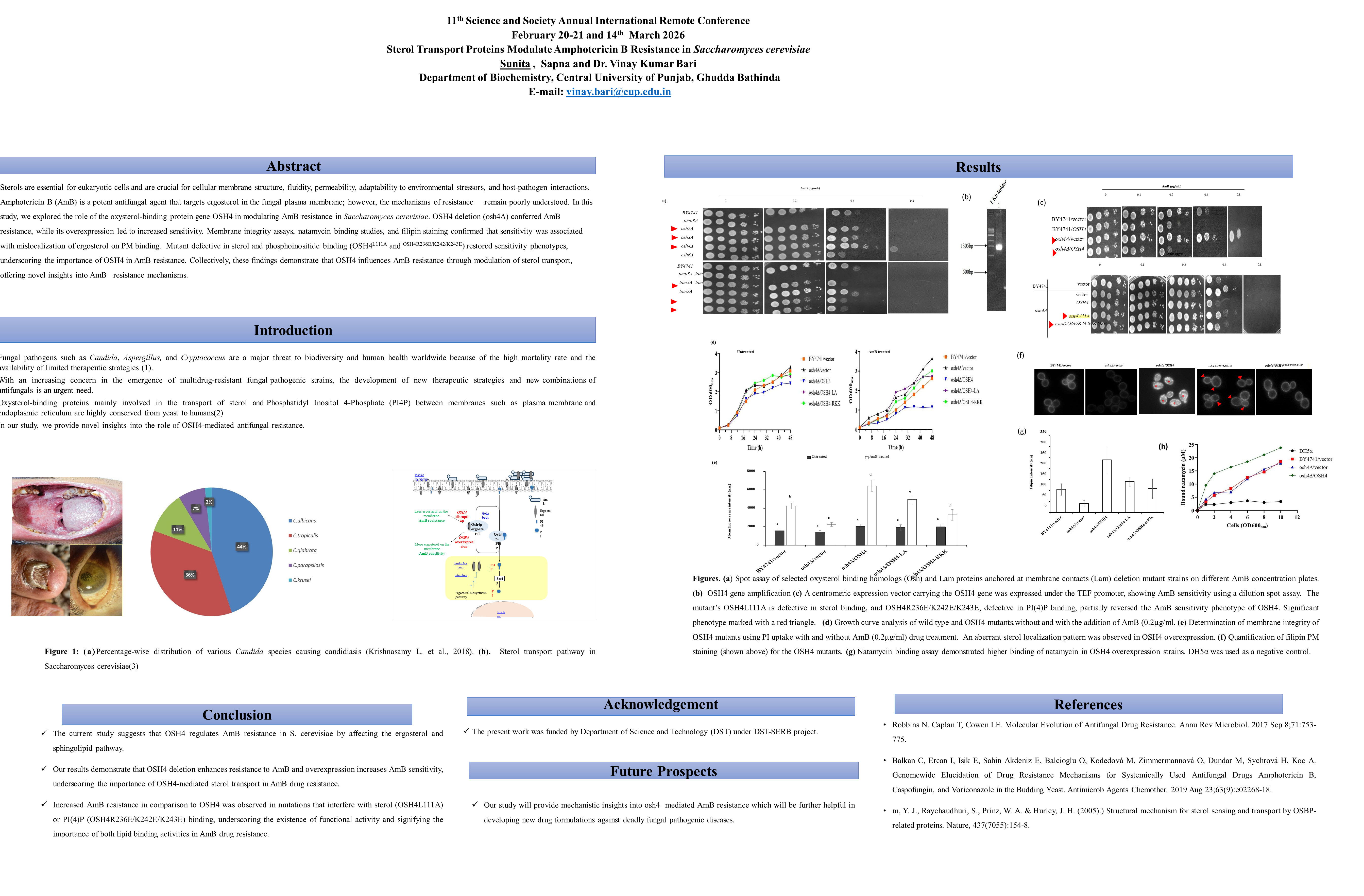
Sterols are essential for eukaryotic cells and are crucial for cellular membrane structure, fluidity, permeability, adaptability to environmental stressors, and host-pathogen interactions. Amphotericin B (AmB) is a potent antifungal agent that targets ergosterol in the fungal plasma membrane; however, the mechanisms of resistance remain poorly understood. In this study, we explored the role of the oxysterol-binding protein gene OSH4 in modulating AmB resistance in Saccharomyces cerevisiae. OSH4 deletion (osh4Δ) conferred AmB resistance, while its overexpression led to increased sensitivity
Methods
Membrane integrity assays, natamycin binding studies, and filipin staining confirmed that sensitivity was associated with mislocalization of ergosterol on PM binding.
Results
In this study, we explored the role of the oxysterol-binding protein gene OSH4 in modulating AmB resistance in Saccharomyces cerevisiae. OSH4 deletion (osh4Δ) conferred AmB resistance, while its overexpression led to increased sensitivity. Mutant defective in sterol and phosphoinositide binding (OSH4L111A and OSH4R236E/K242/K243E) restored sensitivity phenotypes, underscoring the importance of OSH4 in AmB resistance. Collectively, these findings demonstrate that OSH4 influences AmB resistance through modulation of sterol transport, offering novel insights into AmB resistance mechanisms
Conclusions
Our findings demonstrate that deletion of OSH4 confers increased resistance to AmB, while overexpression restores sensitivity, highlighting the importance of oxysterol transport in mediating drug susceptibility. We also explored the role of OSH4 phosphotidylinositol and sterol binding domains critical for lipid transport. Mutations that disrupt sterol (L111A) or PIP (RKK236,242-243E) binding led to increased AmB resistance, highlighting the importance of both lipid-binding activities in mediating drug sensitivity. Overall, our results highlight a significant correlation between the oxysterol transport protein and AmB resistance, suggesting that targeting sterol transport mutant osh4 resistant could be used to develop novel drug formulations against life-threatening diseases caused by fungal pathogens.
Leave A Comment